FIELD NOTES
Observations from individual campaigns. Recorded as heard, before analysis.
Modal survey by tonal excitation
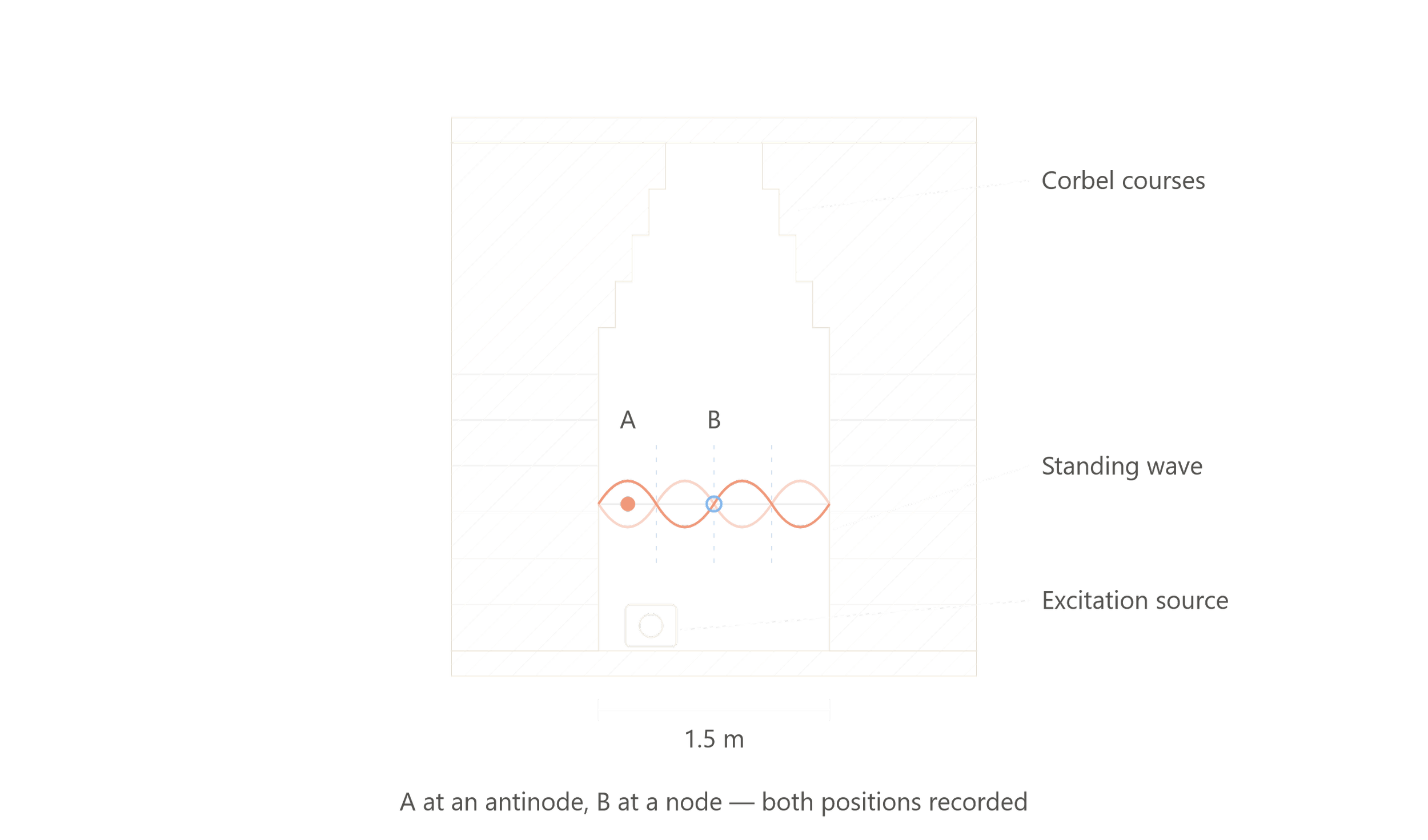
Modal survey by tonal excitation
Rather than an impulse, the chambers were excited with sustained tones. Working from outside the structure, I moved the synthesiser's tuning slowly across the range while watching the spectrum analyser, until a characteristic bell-shaped peak appeared with its harmonics above it. That frequency is the chamber's response.
Once found, the second question is where. The same tone is not equally present everywhere: moving through the space, there are positions where it reinforces strongly and positions where it thins toward cancellation. Both are recorded.
Recombining captures from different positions produces comb filtering — the path-length differences between points put the same frequency in and out of phase across the spectrum, cutting regular notches through it. This is the source of the spectral character of the drones built from this material, and of how they behave when diffused across a room in the installation work.
Recorded during park hours, non-invasively, with no contact with structures.
Tayasal — Petén, Guatemala
Tayasal — Petén, Guatemala
February 2026
Tayasal became a regular site rather than an expedition. Isla de Flores served as base camp for the Uaxactún campaign in the deep forest — a place to return to monthly for reliable internet and data transfer, since in the jungle connectivity runs on radio. From Flores the crossing to Tayasal takes minutes, and I made it most mornings.
The site is a public archaeological park under ongoing investigation by Guatemala's Ministry of Culture and Sports, with free access and marked trails through the excavation zones. Occupation runs continuously from the Preclassic to the Postclassic. Early mornings gave the ambient material: birds, insects, leaves moving in the canopy.
Few chambers at Tayasal are fully enclosed. Most are half-open, which changes their acoustic behaviour — a structure open on one side radiates rather than containing, so its modes are broader and less sharply defined than those of a sealed chamber. They have to be found rather than measured.
Lagunas Rosadas — Celestún, Yucatán, Mexico
June 2025
Days like this start early. Sound check, then selecting the gear — nothing extra, but every cable, adaptor, battery and card the day might need.
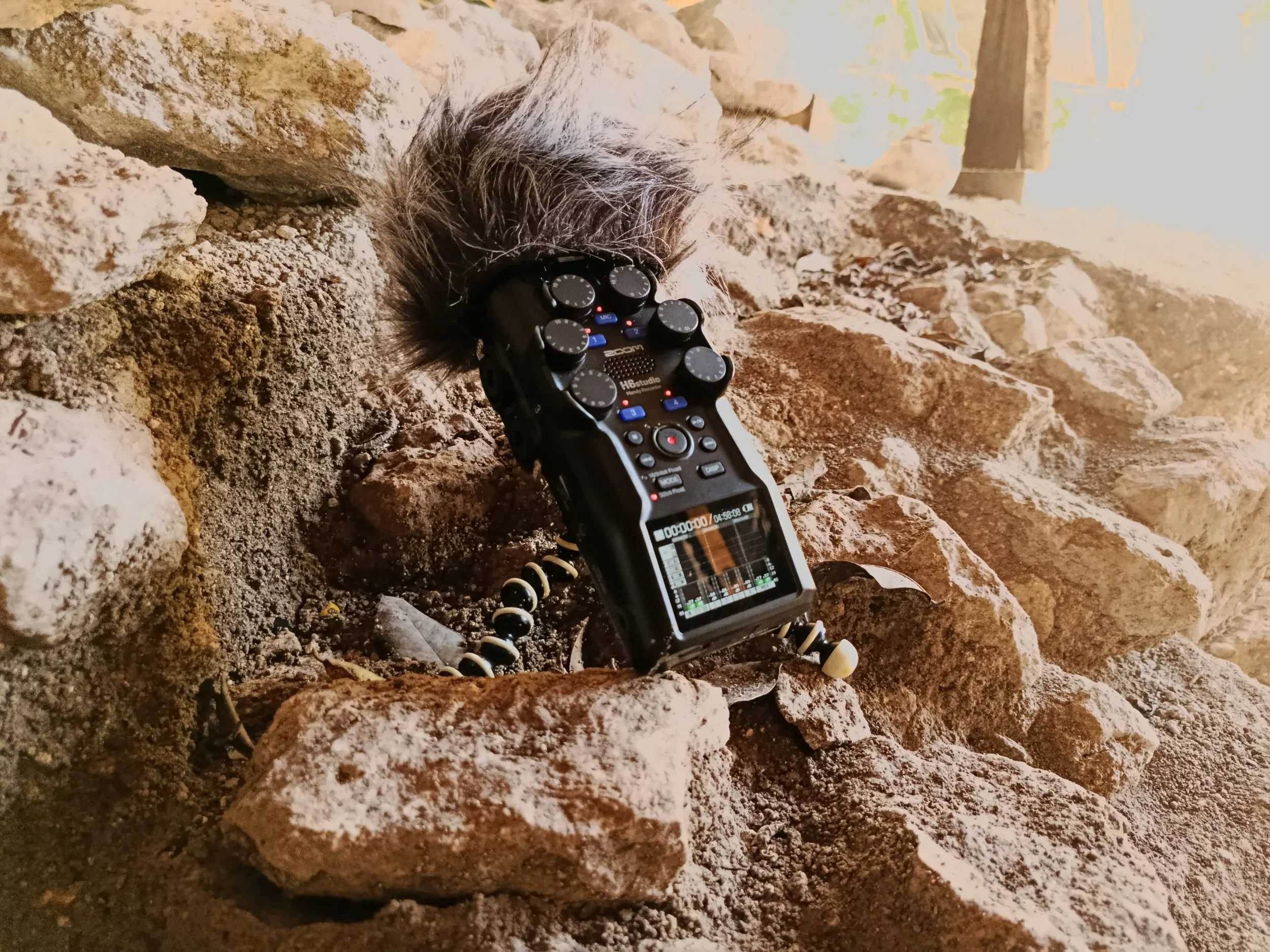
Zoom H6 as fixed recorder, running a pair of Behringer C-2 condensers on phantom power, a piezo contact mic, and a geophone. The C-2s a few millimetres above the salt crust, the piezo laid into it, the geophone planted in it. The H6's own capsules overhead for wind, and an H1 for ambience.
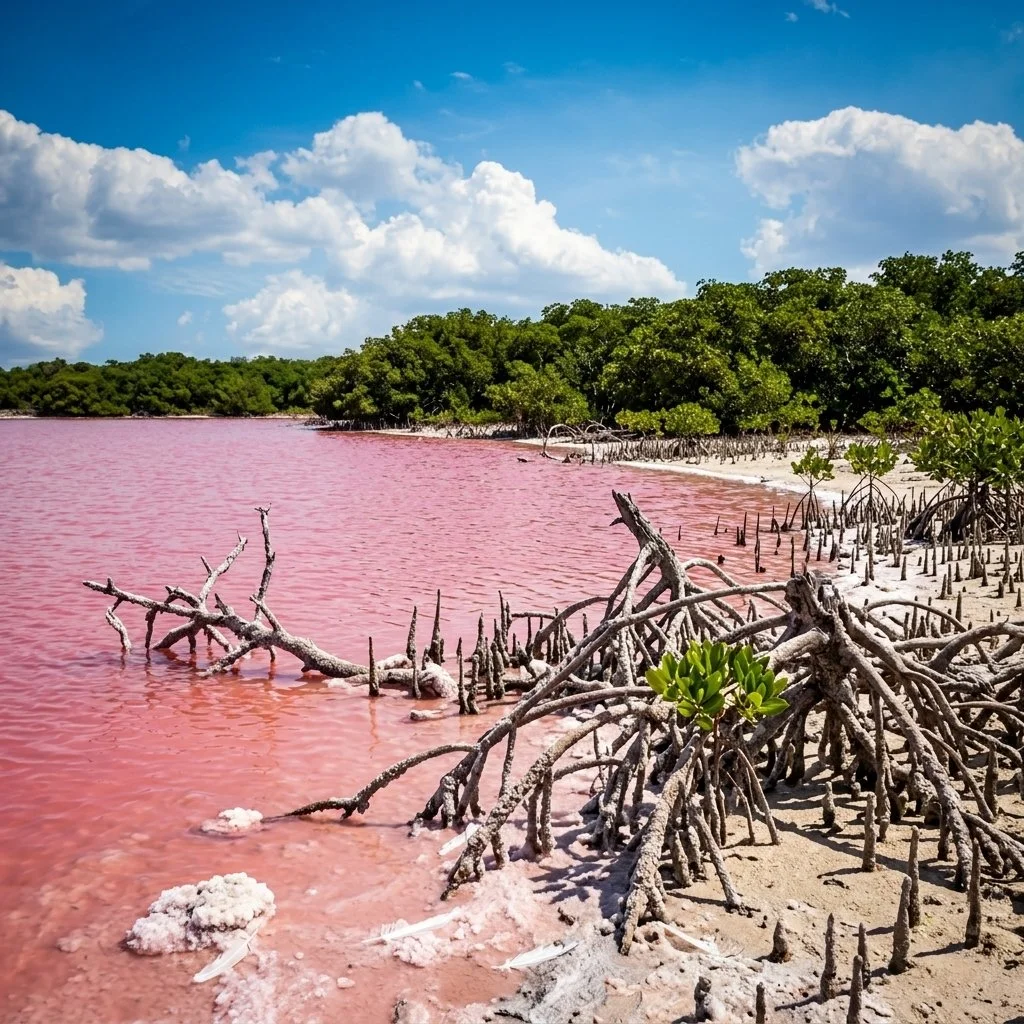
Air above 35 °C, humidity reported at 80–85%. As the brine evaporates the crust dries and crystallises, contracting until it fractures: a crisp granular crackle, close to an ice sheet breaking but with a harder crystalline edge.
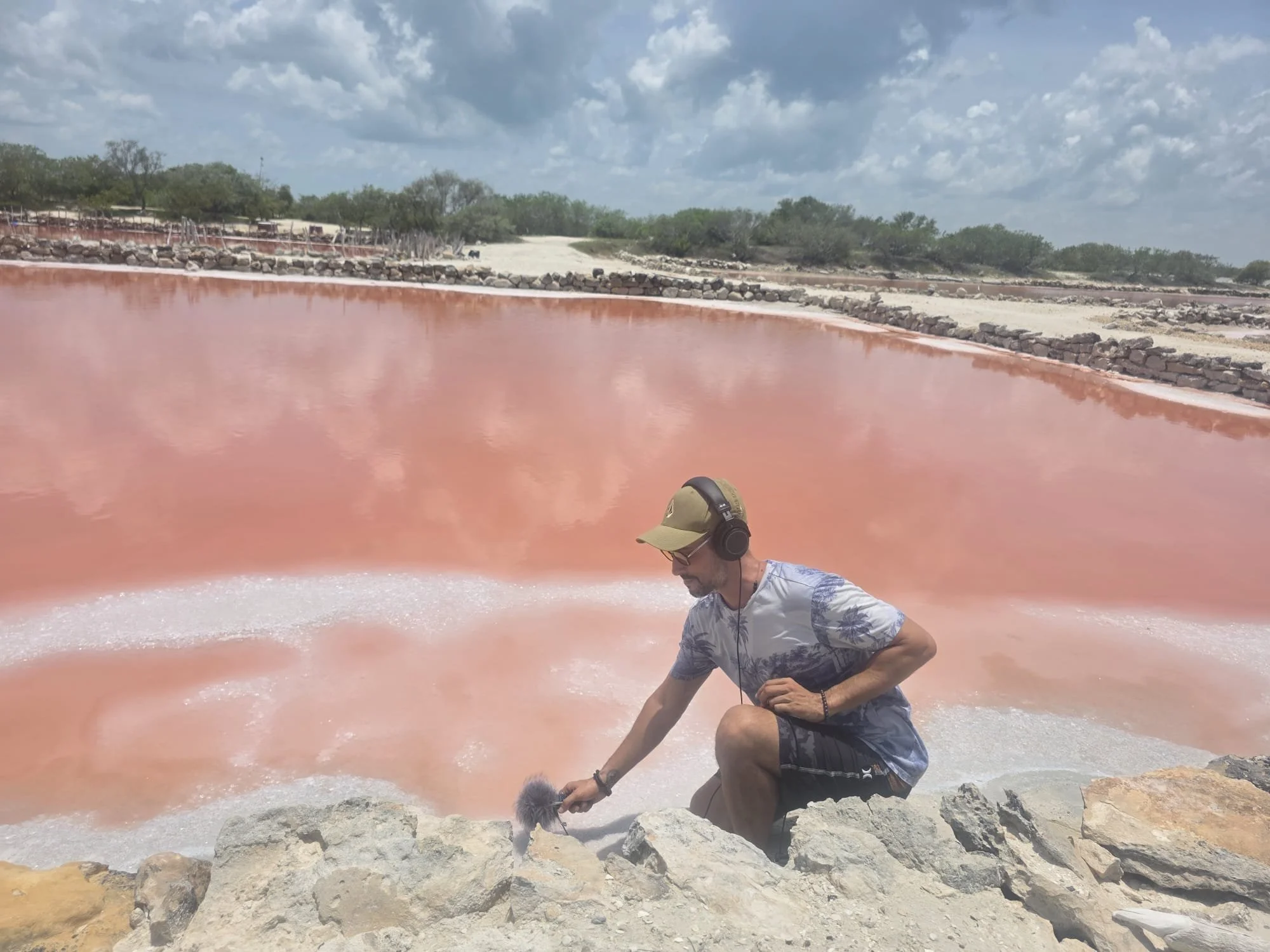
There is no golden hour for this. It took hours of tracking to find where the effect was strongest, and the peak seemed to fall between 15:00 and 16:00 — earlier than that the surface appeared to be still accumulating heat rather than releasing it, though that is an impression rather than a measurement.
The crackle came from the piezo and the geophone, the latter carrying the sub-bass of the fracturing. The C-2 pair carried the detail. The H6 overhead and the H1 gave context — birds, wind, insects — and a great deal of intrusion. The lagoon surface is flat enough to act as a mirror, so a car, a boat, a light aircraft or a helicopter arrives from a long way off and lands cleanly in the recording. Much of the array testing was working out which paths stayed clean.
The material was later processed through granular synthesis, from which the crystalline textures in Pink Crackles are derived.
Next campaign: ground temperature by probe, and humidity measured on site rather than reported.
Cobá–Yaxuná
Reconnaissance — Quintana Roo, Mexico
June 2025
The reasoning. LIDAR survey keeps revealing sacbeob between Maya centres that nobody had recorded, the Cobá–Yaxuná causeway being the best-known case. Cobá is a zone I know well. There are two lagoons there, one in front of the site and one to the side that is largely closed to visitors, and a sacbe runs along that lake edge before disappearing into the forest. The assumption was simple: if some causeways run further than we know, this one might too.
The method. You cannot see a sacbe once you are standing on it. What you can do is align with the restored section INAH has cleared, lock a compass bearing, and walk. My training is partly in cave diving, and the logic transfers: it is an in-and-out mission governed by time rather than distance. You walk a bearing for a fixed duration, and you turn back before the reserve is gone. Under canopy the phone rarely updates, so position is dead reckoning. A ninety-degree turn to investigate something off the line is a serious decision — there is no way to count paces accurately enough to find an invisible bearing again.
Four hours out, with a friend. Not an archaeologist.
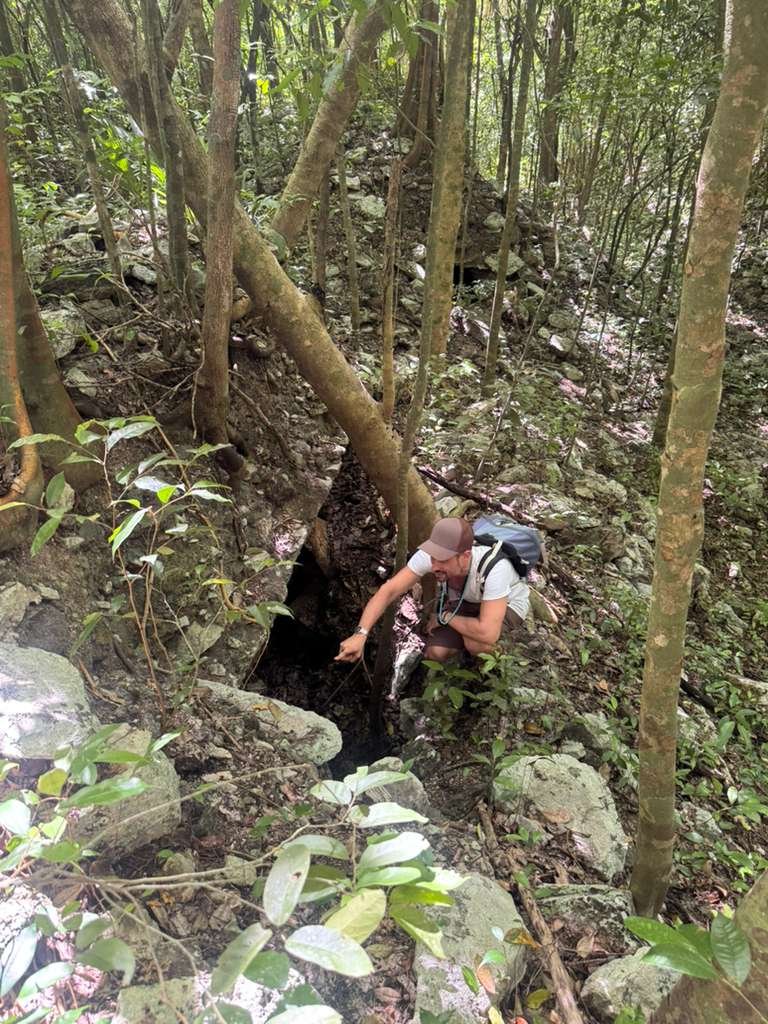
The find. Quintana Roo has almost no natural relief, so a hill is a signal. Archaeologists taught me how to read a montículo, and once you can see them you find hundreds — in Sian Ka'an there are whole cities you can reach on a 250cc. Most have no opening at all; sometimes half a wall survives. This one read as a thick wall in the forest, ten metres high and more than five wide, built of assembled stone in terrain where there is no stone to fall from. If you did not know what you were looking at you would take it for a mound of earth.
It had a cut rectangular opening with square corners, roughly [1.5 m × 0.5 m].
Inside. A shallow entry of about a metre, then rock descending some four metres to a final shaft. The way on was 30 to 60 cm and largely blocked; I did not pass it. Recording was done from the first hall, capturing the cavity and partially the space beyond.
Limestone throughout, and the coursing was unusual — the largest blocks at the top, some two metres by one, with smaller stone beneath and medium blocks below that. It is the opposite of what you normally see. The form read as rectangular, possibly a collapsed vault, but not the corbel profile I know from elsewhere. What made it clearly built rather than geological was the architecture: coursed blocks and openings between chambers.
Air dense and humid, almost still, with a small cold draught coming from the inner chamber through a vent the size of a single block, 20 to 25 cm. Bats, insects, reptiles. Frogs and mosquitoes at the entrance.
The capture. Zoom H1 with a hypercardioid mic. Stereo for the hall, hypercardioid into the shaft and toward the inner chamber. Excitation by hand and by phone through a small speaker: claps, whoops, bursts, clicks, short sweeps. Nothing long — these were first attempts, and we were already out of time.
The exit. We had pushed past the point where we should have turned back, and we recorded when we should already have been walking. The return cost us. We were caught by the night, took some damage getting through it, and reached the car hours late with no camp, no net, no water left. We ate very late in Tulum, and were glad to be intact. The recording was worth having; the timing was a mistake, and I would not repeat it.
What came of it. These became the first impulse responses I worked with, and they changed how I compose. The high-frequency content was unlike anything I expected — the chamber was not a single resonance but a full resonant body, complex enough to modulate other material rather than simply colour it.
It also ended something for me. I had been working near the solfeggio frequencies, the way a lot of people in this field do. Running the analysis on these responses made that untenable. What a chamber does to sound is not one number. It is a dense, position-dependent, phase-sensitive structure, and the claims made for individual frequencies do not survive contact with a real measurement. That shift is the reason this work became archaeoacoustics rather than sound healing.
Status. No excavation, no removal, no contact with structures beyond entering the first hall. The feature is unrecorded as far as I know, and I have no way to confirm what it is. I intend to report it, along with structures closer to Cobá that I could relocate reliably, to Centro INAH Quintana Roo, and would welcome the chance to return under their supervision and record properly.
The Voice of the Stela
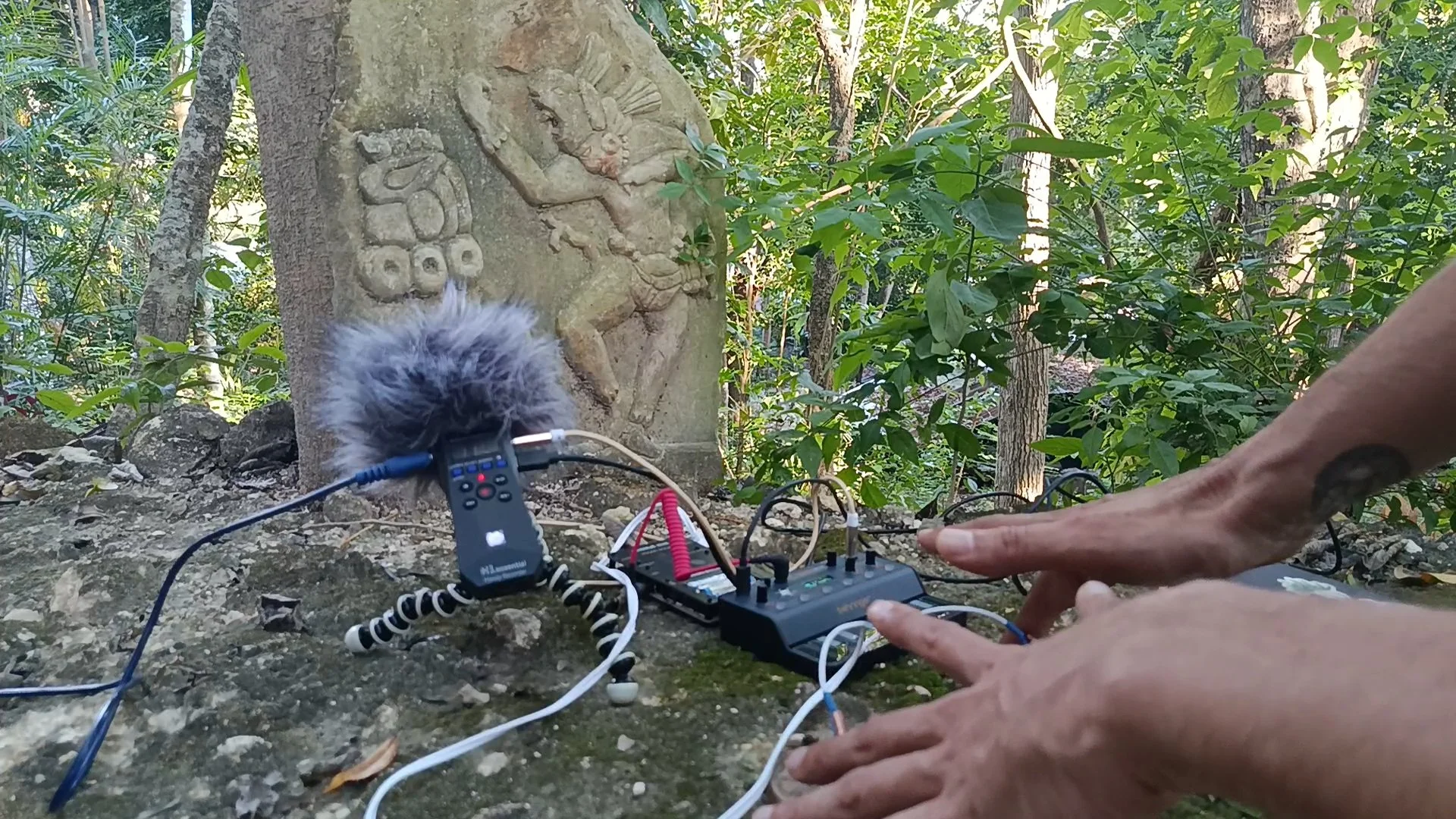
Field Notes : The Voice of the Stela
This partial stela was rescued from looting, shielded from the elements, and saved from private collection, preserving its physical integrity.
Using geophones and micro-impulse sensors, I captured the subtle vibrational and electrical activity within the stone itself.
These micro-impulses were converted into MIDI notes, driving a compact synth engine tuned to the stone’s most natural, pure waveforms.
As the live audio processed, sporadic, almost intentional melodic phrases began surfacing in the background, giving voice to an ancient silent artifact.